



Russell P. Strange Memorial Book of the Year Award
Honoring the definitive voices in the history of the Prairie State.
The Russell P. Strange Memorial Book of the Year Award was established by Darrell and Priscilla Strange Matthews in memory of Priscilla’s father, noted scholar, educator, past vice president and life-long member of the Illinois State Historical Society.
About this
Award
The award is presented annually to one author in recognition of his/her significant contribution to the study of Illinois history. It is presented at the Annual Awards Banquet in April together with a cash award authorized by the Board of Directors of the Illinois State Historical Society.
Application Criteria & Excellence
-
The award is presented annually to one author in recognition of his/her significant contribution to the study of Illinois history. It is presented at the Annual Awards Banquet in April together with a cash award authorized by the Board of Directors of the Illinois State Historical Society.
Submission & Inquiries
Complete and mail four (4) copies of the nomination form with four (4) copies of your supporting materials to:
Illinois State Historical Society
PO Box 1800
Springfield, IL
62705-1800
Nominations must be postmarked by November 30 of every year.
Please include a $50 entry fee, made payable to the Illinois State Historical Society.
For more information, please call 217-525-2781 or email kim.jones@HistoryIllinois.org.
One copy of every publication nominated will be retained for the ISHS’s office library.
About Colonel Russell P. Strange
Colonel Russell P. Strange (1922–1966) was a distinguished Air Force officer, educator, and historian whose career bridged military service, higher education, and public history. His leadership, scholarship, and commitment to teaching left a lasting impact on the institutions and communities he served in Illinois and beyond.

Early Life and Education
Russell P. Strange was born on August 6, 1922, in Granite City, Illinois. He graduated from high school in Madison in 1940 and entered the University of Illinois that fall.
When World War II broke out, he was the first Air Force Reserved Officer Training Corps (ROTC) cadet to volunteer for military service, enlisting in the Army Air Corps in January 1942. He attended Officer Candidate School and was commissioned on January 19, 1943. He married Doris Smith of Council Grove, Kansas, in December 1943.
World War II and Postwar Service
During World War II, Colonel Strange served as a training officer. From 1945 to 1952, he continued his service in the Air Force in Washington, D.C., while attending the Air Tactical School, from which he graduated in 1949. During this time, he also resumed his formal education at the University of Maryland, earning a degree in American history in 1952.
Advanced Studies & Overseas Service
Continuing his education at the University of Maryland while assigned to the U.S. Naval Academy from 1952 to 1955, Strange received his master’s degree in 1953 and his doctorate in government and politics in 1955. He then entered the command staff school of the Air University, graduating in 1956, and was assigned to Japan. There, he worked in the psychological warfare section of the Far East Command until it was deactivated and later served as secretary of the Joint Staff of U.S. forces in Japan from 1957 to 1959. While in Japan, he taught political science at Sophia University, a Jesuit school in Tokyo, and for the University of Maryland’s Far East division.
Leadership in Illinois and Academic Roles
Assigned to the Pentagon in 1959, Colonel Strange served as chief of the school branch of the officer assignment division, where he helped double the number of Air Force volunteer scientists and engineers educated in American universities. In 1962, he returned to Illinois to head the University of Illinois Department of Aerospace Studies, lead he Air Force detachment in Champaign, and teach graduate courses in political science. When ROTC became a voluntary program in 1963, he developed a new program for the unit and remained active in area civic and political groups with a special focus on history and education.
Final Appointment and Legacy
In 1966, Colonel Strange was named acting head of political studies at Eastern Illinois University in Charleston. He was killed in a car accident in October 1966 while traveling to Charleston. At the time of his death, he was a Director, former vice-president, and long-time member of the Illinois State Historical Society, reflecting his deep dedication to the study and preservation of Illinois history.
2025-2020
Russell P. Strange Award Winners
Collapsible text is perfect for longer content like paragraphs and descriptions. It's a great way to give people more information while keeping your layout clean. Link your text to anything, including an external website or a different page. You can set your text box to expand and collapse when people click, so they can read more or less info.

2025
Brian Mullgardt
Wear Some Armor in Your Hair:
Urban Renewal and the 1968 Democratic National Convention in Lincoln Park
Brings together Chicago history, the 1960s, and urbanization, focusing not on the national leaders, but on the grassroots activists of the time. In August of 1968, approximately 7,000 people protested the Vietnam War against the backdrop of the Democratic National Convention in Chicago. This highly televised event began peacefully but quickly turned into what was later termed a “police riot.” Brian Mullgardt’s investigation of this event and the preceding tensions shines a light on the ministers, Yippies, and community members who showed up and stood together against the brutality of the police. Beginning in 1955, two competing visions of urban renewal existed, and the groups that propounded each clashed publicly, but peacefully. One group, linked to city hall, envisioned a future Lincoln Park that paid lip service to diversity but actually included very little. The other group, the North Side Cooperative Ministry, offered a different vision of Lincoln Park that was much more diverse in terms of class and race. When the Yippies announced anti-war protests for the summer of ‘68, the North Side Cooperative Ministry played an instrumental role. Ultimately, the violence of that week altered community relations and the forces of gentrification won out.
Mullgardt’s focus on the activists and community members of Lincoln Park, a neighborhood at the nexus of national trends, broadens the scope of understanding around a pivotal and monumental chapter of our history. The story of Lincoln Park, Chicago, is in many ways the story of 1960s activism writ small, and in other ways challenges us to view national trends differently.
Collapsible text is perfect for longer content like paragraphs and descriptions. It's a great way to give people more information while keeping your layout clean. Link your text to anything, including an external website or a different page. You can set your text box to expand and collapse when people click, so they can read more or less info.
2024
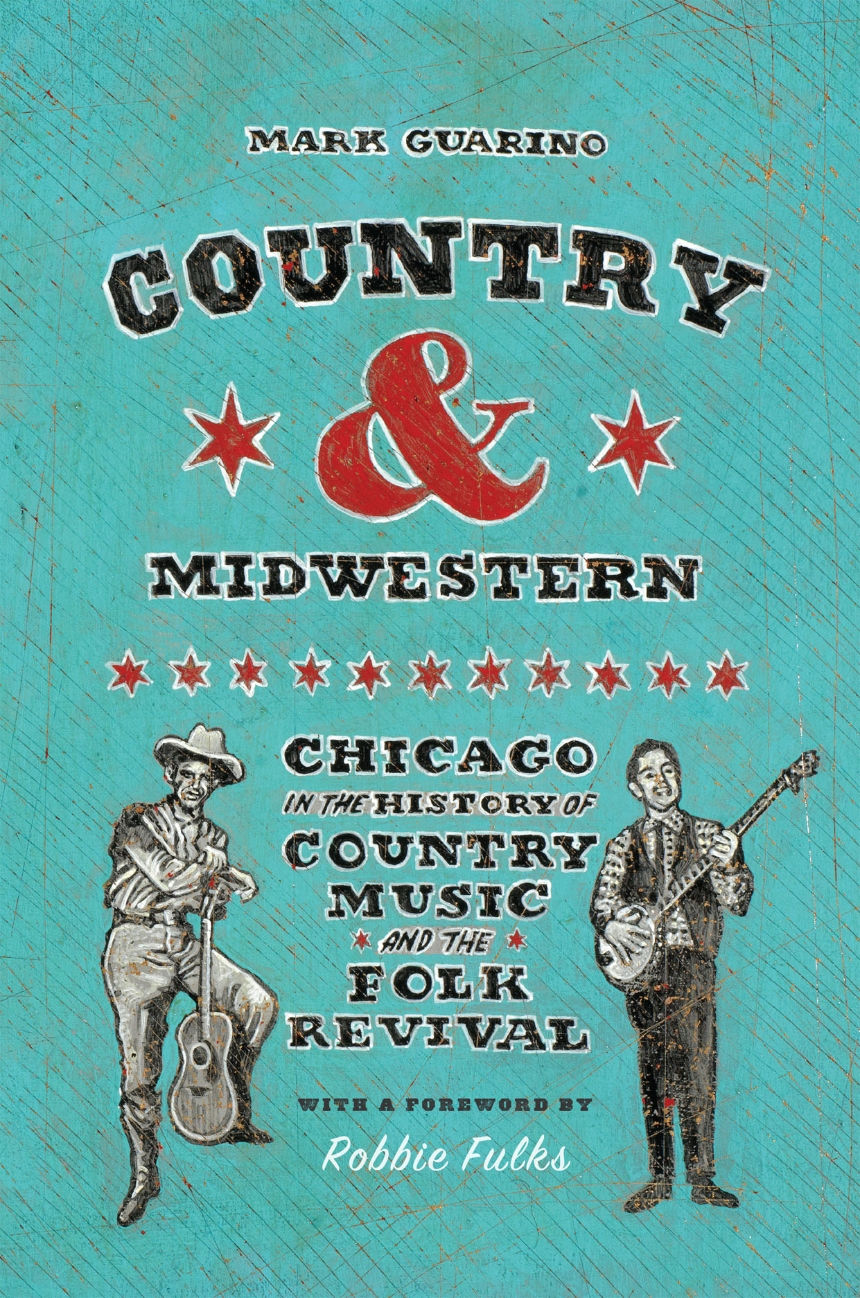
Mark Guarino
Country and Midwestern: The untold story of Chicago’s pivotal role as a country and folk music capital. Chicago is revered as a musical breeding ground, having launched major figures like blues legend Muddy Waters, gospel soul icon Mavis Staples, hip-hop firebrand Kanye West, and the jazz-rock band that shares its name with the city. Far less known, however, is the vital role Chicago played in the rise of prewar country music, the folk revival of the 1950s and 1960s, and the contemporary offspring of those scenes.
In Country and Midwestern, veteran journalist Mark Guarino tells the epic century-long story of Chicago’s influence on sounds typically associated with regions further south. Drawing on hundreds of interviews and deep archival research, Guarino tells a forgotten story of music, migration, and the ways that rural culture infiltrated urban communities through the radio, the automobile, and the railroad. The Midwest’s biggest city was the place where rural transplants could reinvent themselves and shape their music for the new commercial possibilities the city offered. Years before Nashville emerged as the commercial and spiritual center of country music, major record labels made Chicago their home and recorded legendary figures like Bill Monroe, The Carter Family, and Gene Autry. The National Barn Dance—broadcast from the city’s South Loop starting in 1924—flourished for two decades as the premier country radio show before the Grand Ole Opry. Guarino chronicles the makeshift niche scenes like “Hillbilly Heaven” in Uptown, where thousands of relocated Southerners created their own hardscrabble honky-tonk subculture, as well as the 1960s rise of the Old Town School of Folk Music, which eventually brought national attention to local luminaries like John Prine and Steve Goodman. The story continues through the end of the twentieth century and into the present day, where artists like Jon Langford, The Handsome Family, and Wilco meld contemporary experimentation with country traditions.
Featuring a foreword from Grammy-nominated singer-songwriter Robbie Fulks and casting a cross-genre net that stretches from Bob Dylan to punk rock, Country and Midwestern rediscovers a history as sprawling as the Windy City—celebrating the creative spirit that modernized American folk idioms, the colorful characters who took them into new terrain, and the music itself, which is still kicking down doors even today.
Collapsible text is perfect for longer content like paragraphs and descriptions. It's a great way to give people more information while keeping your layout clean. Link your text to anything, including an external website or a different page. You can set your text box to expand and collapse when people click, so they can read more or less info.
2023
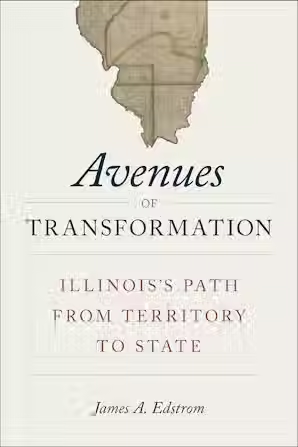
James Edstrom
Avenues of Transformation
Traces the surprising path, marked by shame, ambition, and will that led to Illinois’s admission to the Union in 1818. Historian James A. Edstrom guides the reader through this story by associating each stage of the narrative—the original statehood campaign, the passage of Illinois’s statehood-enabling act by Congress, and Illinois’s first constitutional convention—with the primary leaders in each of those episodes. The lives of these men—Daniel Pope Cook, Nathaniel Pope, and Elias Kent Kane—reflect the momentous tangle of politics, slavery, and geography. This history maps the drive for statehood in the conflict between nation and state, in the perpetuation of slavery, and in the sweep of water and commerce. It underscores the ways in which the Prairie State is uniquely intertwined—economically, socially, and politically—with every region of the Union: North, South, East, and West—and captures the compelling moment when Illinois statehood stood ready to more perfectly unify the nation.
This volume is the first full-length book in over a century to describe and analyze Illinois’s admission to the Union. It marks the first time that a historian has analyzed in detail the roll-call votes of the first state constitutional convention, seated evenly by pro- and antislavery delegates. Edstrom’s wit and prose weave a lively narrative of political ambition and human failure. Patiently crafted, Avenues of Transformation will be the first source for readers to turn to for gaining a better understanding of Illinois statehood.
Collapsible text is perfect for longer content like paragraphs and descriptions. It's a great way to give people more information while keeping your layout clean. Link your text to anything, including an external website or a different page. You can set your text box to expand and collapse when people click, so they can read more or less info.
2022
Jonathan Wright & Dawson Barrett
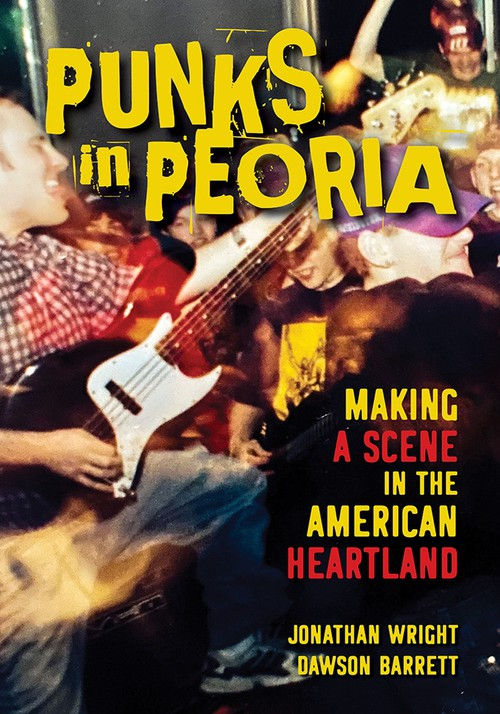
Punks in Peoria: Making a Scene in the American Heartland
A raucous look at a small-city underground, Punks in Peoria takes readers off the beaten track to reveal the punk rock life as lived in Anytown, U.S.A.
Synonymous with American mediocrity, Peoria was fertile ground for the boredom- and anger-fueled fury of punk rock. Jonathan Wright and Dawson Barrett explore the do-it-yourself scene built by Peoria punks, performers, and scenesters in the 1980s and 1990s. From fanzines to indie record shops to renting the VFW hall for an all-ages show, Peoria's punk culture reflected the movement elsewhere, but the region's conservatism and industrial decline offered a richer-than-usual target environment for rebellion. Eyewitness accounts take readers into hangouts and long-lost venues, while interviews with the people who were there trace the ever-changing scene and varied fortunes of local legends like Caustic Defiance, Dollface, and Planes Mistaken for Stars. What emerges is a sympathetic portrait of a youth culture in search of entertainment but just as hungry for community—the shared sense of otherness that, even for one night only, could unite outsiders and discontents under the banner of music.
Collapsible text is perfect for longer content like paragraphs and descriptions. It's a great way to give people more information while keeping your layout clean. Link your text to anything, including an external website or a different page. You can set your text box to expand and collapse when people click, so they can read more or less info.

2020
Mark Flotow
In their Letters, in Their Words: Illinois Civil War Soldiers Write Home
A vital lifeline to home during the Civil War, the letters of soldiers to their families and friends remain a treasure for those seeking to connect with and understand the most turbulent period of American history. Rather than focus on the experiences of a few witnesses, this impressively researched book documents 165 Illinois Civil War soldiers’ and sailors’ lives through the lens of their personal letters. Editor Mark Flotow chose a variety of letter writers who hailed from counties throughout the state, served in different branches of the military at different ranks, and represented the gamut of social experiences and war outcomes.
Flotow provides extensive quotations from the letters. By allowing the soldiers to speak for themselves, he captures what mattered most to them. Illinois soldiers wrote about their reasons for enlisting; the nature of training and duties; necessities like eating, sleeping, marching, and making the best of often harsh and chaotic circumstances; Southern culture; slavery; their opinions of commanding officers and the president; disease, medicine, and hospitals; their prisoner-of-war experiences; and the ways they left the army. Through letters from afar, many soldiers sought to manage their homes and farms, while some single men attempted to woo their sweethearts.
Flotow includes brief biographies for each soldier quoted in the book, weaves historical context and analysis with the letters, and organizes them by topic. Thus, intimate details cited in individual letters reveal their significance for those who lived and shaped this tumultuous era. The result is not only insightful history but also compelling reading.
Previous Recipients
Explore past recipients of the Russell P. Strange Memorial Book of the Year Award and their contributions to Illinois history.
Scroll to View
2019
Frank Cicero, Jr.
Creating the Land of Lincoln: The History and Constitutions of Illinois
2018
Graham A. Peck
Making an Antislavery Nation: Lincoln, Douglas, and the Battle Over Freedom
2017
Joseph Gustaitis
Chicago Transmed: World War I and the Windy City
2016
Dominic Pacyga
Slaughterhouse: Chicago’s Union Stockyard and the World It Made
2015
Ted Karamanski and Eileen McMahon
Civil War Chicago: Eyewitness to History
2014
Dennis Cremin
Grant Park: The Evolution of Chicago’s Front Yard
2013
Jason Emerson
Giant in the Shadows: The Life of Robert T. Lincoln
2012
Gillum Ferguson
Illinois and the War of 1812
2011
Robert A. Bray
Reading with Lincoln
2009
Michael Burlingame
Abraham Lincoln: A Life
2008
Robert Mazrim
The Sangamo Frontier: History and Archaeology in the Shadow of Lincoln
2007
Jason Emerson
The Madness of Mary Lincoln
2006
Louise W. Knight
Citizen: Jane Addams and the Struggle Democracy
2025-2020
Russell P. Strange Award Winners
Wear Some Armor in Your Hair:
Urban Renewal and the 1968 Democratic National Convention in Lincoln Park
Brings together Chicago history, the 1960s, and urbanization, focusing not on the national leaders, but on the grassroots activists of the time. In August of 1968, approximately 7,000 people protested the Vietnam War against the backdrop of the Democratic National Convention in Chicago. This highly televised event began peacefully but quickly turned into what was later termed a “police riot.” Brian Mullgardt’s investigation of this event and the preceding tensions shines a light on the ministers, Yippies, and community members who showed up and stood together against the brutality of the police. Beginning in 1955, two competing visions of urban renewal existed, and the groups that propounded each clashed publicly, but peacefully. One group, linked to city hall, envisioned a future Lincoln Park that paid lip service to diversity but actually included very little. The other group, the North Side Cooperative Ministry, offered a different vision of Lincoln Park that was much more diverse in terms of class and race. When the Yippies announced anti-war protests for the summer of ‘68, the North Side Cooperative Ministry played an instrumental role. Ultimately, the violence of that week altered community relations and the forces of gentrification won out.
Mullgardt’s focus on the activists and community members of Lincoln Park, a neighborhood at the nexus of national trends, broadens the scope of understanding around a pivotal and monumental chapter of our history. The story of Lincoln Park, Chicago, is in many ways the story of 1960s activism writ small, and in other ways challenges us to view national trends differently.
2025
Brian Mullgardt
Country and Midwestern: The untold story of Chicago’s pivotal role as a country and folk music capital. Chicago is revered as a musical breeding ground, having launched major figures like blues legend Muddy Waters, gospel soul icon Mavis Staples, hip-hop firebrand Kanye West, and the jazz-rock band that shares its name with the city. Far less known, however, is the vital role Chicago played in the rise of prewar country music, the folk revival of the 1950s and 1960s, and the contemporary offspring of those scenes.
In Country and Midwestern, veteran journalist Mark Guarino tells the epic century-long story of Chicago’s influence on sounds typically associated with regions further south. Drawing on hundreds of interviews and deep archival research, Guarino tells a forgotten story of music, migration, and the ways that rural culture infiltrated urban communities through the radio, the automobile, and the railroad. The Midwest’s biggest city was the place where rural transplants could reinvent themselves and shape their music for the new commercial possibilities the city offered. Years before Nashville emerged as the commercial and spiritual center of country music, major record labels made Chicago their home and recorded legendary figures like Bill Monroe, The Carter Family, and Gene Autry. The National Barn Dance—broadcast from the city’s South Loop starting in 1924—flourished for two decades as the premier country radio show before the Grand Ole Opry. Guarino chronicles the makeshift niche scenes like “Hillbilly Heaven” in Uptown, where thousands of relocated Southerners created their own hardscrabble honky-tonk subculture, as well as the 1960s rise of the Old Town School of Folk Music, which eventually brought national attention to local luminaries like John Prine and Steve Goodman. The story continues through the end of the twentieth century and into the present day, where artists like Jon Langford, The Handsome Family, and Wilco meld contemporary experimentation with country traditions.
Featuring a foreword from Grammy-nominated singer-songwriter Robbie Fulks and casting a cross-genre net that stretches from Bob Dylan to punk rock, Country and Midwestern rediscovers a history as sprawling as the Windy City—celebrating the creative spirit that modernized American folk idioms, the colorful characters who took them into new terrain, and the music itself, which is still kicking down doors even today.
2024
Mark Guarino
Avenues of Transformation
Traces the surprising path, marked by shame, ambition, and will that led to Illinois’s admission to the Union in 1818. Historian James A. Edstrom guides the reader through this story by associating each stage of the narrative—the original statehood campaign, the passage of Illinois’s statehood-enabling act by Congress, and Illinois’s first constitutional convention—with the primary leaders in each of those episodes. The lives of these men—Daniel Pope Cook, Nathaniel Pope, and Elias Kent Kane—reflect the momentous tangle of politics, slavery, and geography. This history maps the drive for statehood in the conflict between nation and state, in the perpetuation of slavery, and in the sweep of water and commerce. It underscores the ways in which the Prairie State is uniquely intertwined—economically, socially, and politically—with every region of the Union: North, South, East, and West—and captures the compelling moment when Illinois statehood stood ready to more perfectly unify the nation.
This volume is the first full-length book in over a century to describe and analyze Illinois’s admission to the Union. It marks the first time that a historian has analyzed in detail the roll-call votes of the first state constitutional convention, seated evenly by pro- and antislavery delegates. Edstrom’s wit and prose weave a lively narrative of political ambition and human failure. Patiently crafted, Avenues of Transformation will be the first source for readers to turn to for gaining a better understanding of Illinois statehood.
2023
James Edstrom
Punks in Peoria: Making a Scene in the American Heartland
A raucous look at a small-city underground, Punks in Peoria takes readers off the beaten track to reveal the punk rock life as lived in Anytown, U.S.A.
Synonymous with American mediocrity, Peoria was fertile ground for the boredom- and anger-fueled fury of punk rock. Jonathan Wright and Dawson Barrett explore the do-it-yourself scene built by Peoria punks, performers, and scenesters in the 1980s and 1990s. From fanzines to indie record shops to renting the VFW hall for an all-ages show, Peoria's punk culture reflected the movement elsewhere, but the region's conservatism and industrial decline offered a richer-than-usual target environment for rebellion. Eyewitness accounts take readers into hangouts and long-lost venues, while interviews with the people who were there trace the ever-changing scene and varied fortunes of local legends like Caustic Defiance, Dollface, and Planes Mistaken for Stars. What emerges is a sympathetic portrait of a youth culture in search of entertainment but just as hungry for community—the shared sense of otherness that, even for one night only, could unite outsiders and discontents under the banner of music.
2022
Jonathan Wright & Dawson Barrett
In their Letters, in Their Words: Illinois Civil War Soldiers Write Home
A vital lifeline to home during the Civil War, the letters of soldiers to their families and friends remain a treasure for those seeking to connect with and understand the most turbulent period of American history. Rather than focus on the experiences of a few witnesses, this impressively researched book documents 165 Illinois Civil War soldiers’ and sailors’ lives through the lens of their personal letters. Editor Mark Flotow chose a variety of letter writers who hailed from counties throughout the state, served in different branches of the military at different ranks, and represented the gamut of social experiences and war outcomes.
Flotow provides extensive quotations from the letters. By allowing the soldiers to speak for themselves, he captures what mattered most to them. Illinois soldiers wrote about their reasons for enlisting; the nature of training and duties; necessities like eating, sleeping, marching, and making the best of often harsh and chaotic circumstances; Southern culture; slavery; their opinions of commanding officers and the president; disease, medicine, and hospitals; their prisoner-of-war experiences; and the ways they left the army. Through letters from afar, many soldiers sought to manage their homes and farms, while some single men attempted to woo their sweethearts.
Flotow includes brief biographies for each soldier quoted in the book, weaves historical context and analysis with the letters, and organizes them by topic. Thus, intimate details cited in individual letters reveal their significance for those who lived and shaped this tumultuous era. The result is not only insightful history but also compelling reading.
2020
Mark Flotow
Nominate a Definitive Voice in Illinois History.
Know a definitive voice in history that deserves to be recognized with the Russell P. Strange Memorial Book of the Year Award? Nominate them today.
Help us honor outstanding works that deepen our understanding of Illinois history and culture.
Download the submission form today!